
Crescent Earth, Blazing Corona, Lunar Shadows Alive! Check Out Artemis II’s Jaw-Dropping Space Gallery
From a glowing Earthrise to a rare solar eclipse in deep space, the Artemis II crew delivers breathtaking visuals and groundbreaking science from humanity’s return to the Moon.
- Science News
- 3 min read

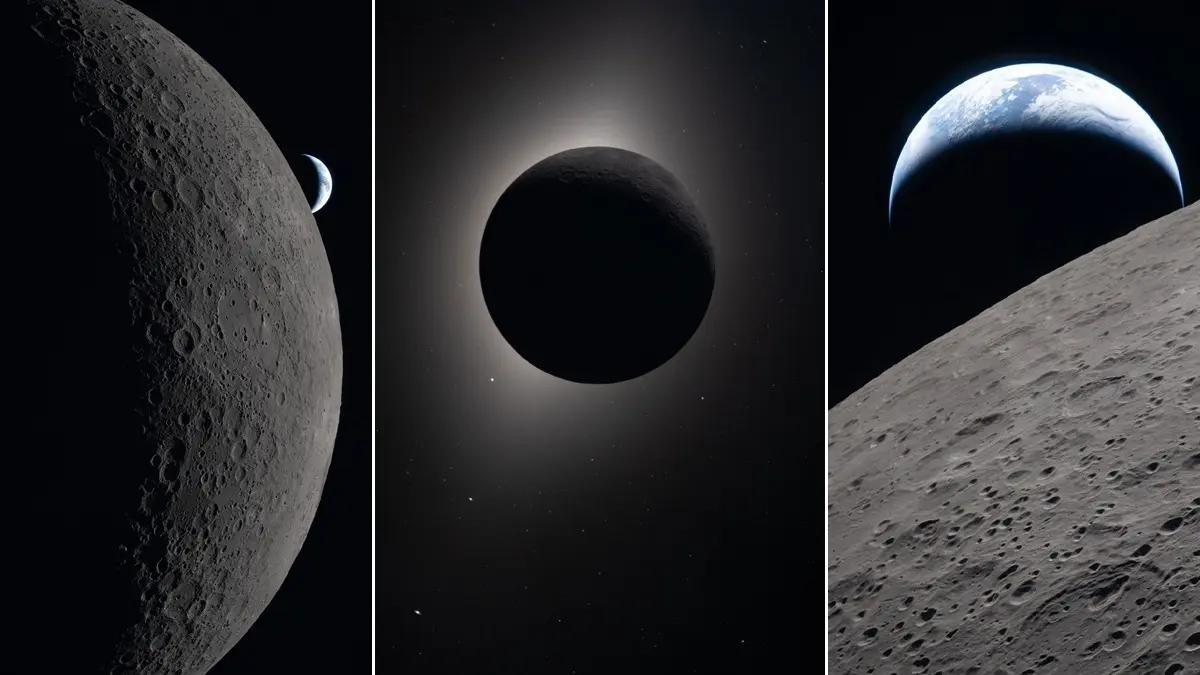
NASA has released the first stunning images from its Artemis II mission, showing a perspective of the Moon that even past missions never fully captured.
Beamed back to Earth after a seven-hour flyby on April 6, the images showcase a dramatic sweep of the lunar far side, revealing jagged ridges, deep impact craters and ancient lava plains in extraordinary detail. Some of these regions, scientists say, have never been observed directly by human eyes.
Among the most captivating visuals is a modern-day echo of a historic moment: an Earthrise, where our planet appears as a delicate crescent emerging from behind the Moon’s horizon. The image instantly recalls the iconic 1968 photograph taken during Apollo 8, but this time, captured with cutting-edge imaging systems and from a deeper, more dynamic vantage point.

The crew also documented a rare solar eclipse from space, capturing the Sun’s corona glowing behind the darkened lunar silhouette, an alignment visible only from this unique orbital path. In another remarkable observation, astronauts recorded six meteoroid impact flashes, brief bursts of light as space debris struck the Moon’s surface in real time.
Advertisement
Even more intriguing are the subtle colour variations the astronauts reported, hints of brown, green and orange across the otherwise grey terrain. These hues, now being analysed, could unlock new clues about the Moon’s chemical composition and geological history.
High-resolution images of massive formations like the Orientale impact basin, spanning nearly 950 km, are expected to deepen scientific understanding of how the Moon evolved over billions of years.
Advertisement
“Our astronauts brought back images so exquisite and brimming with science, they will inspire generations,” said NASA’s science leadership, as teams begin poring over the data.
Captured using a sophisticated suite of cameras aboard the Orion spacecraft, the visuals mark a critical step in preparing for long-term lunar exploration, and eventually, human missions to Mars.