
Artemis II Has a Fifth Passenger, And It’s Already Taking Over the Mission
NASA’s Artemis II mission has a surprise “fifth crew member”. It continues a decades‑old tradition while inspiring young dreamers worldwide.
- Science News
- 4 min read

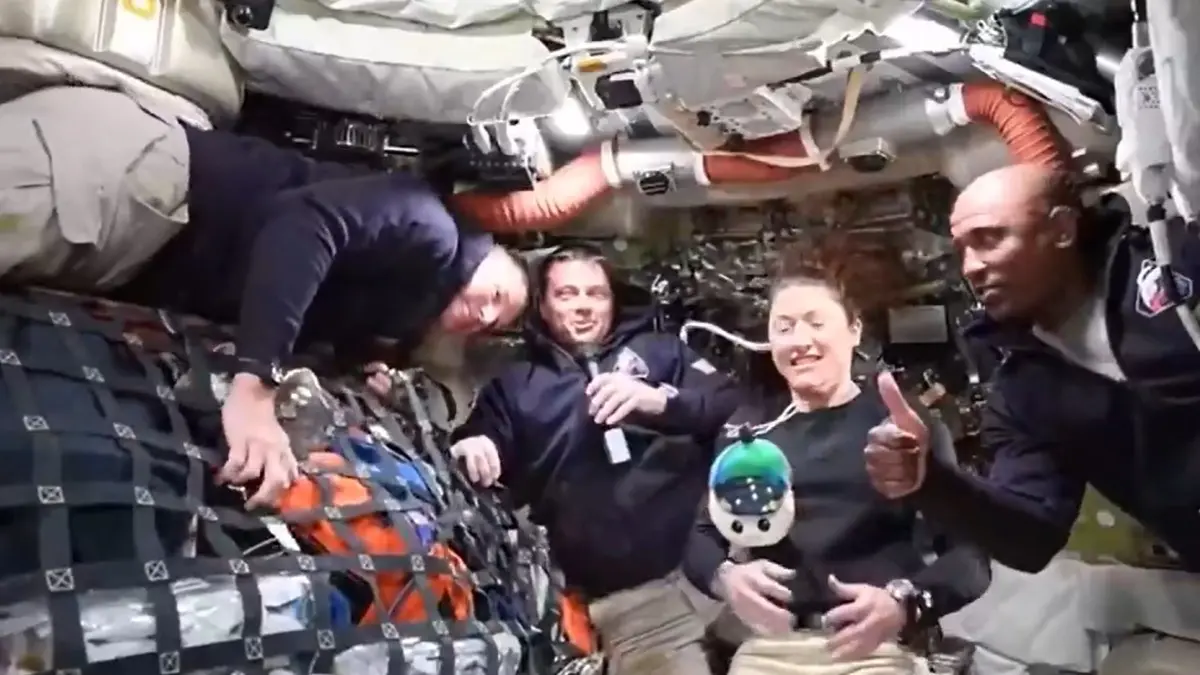
As Artemis II prepares to carry humans back to home from Moon’s neighbourhood, there’s an unexpected name buzzing around the mission logs - a “fifth crew member” who isn’t listed on any official astronaut roster.
The four-person crew - Reid Wiseman, Victor Glover, Christina Koch and Jeremy Hansen have spent days around the Moon aboard NASA’s Orion spacecraft. But somewhere inside that capsule, quietly doing its job, is a small object that signals one of the most important milestones of the journey: the moment they left the Earth’s gravity behind.
Meet the mission’s most unusual crew member
The mystery “passenger” is Rise - a soft, round, white plush toy that has quickly become the internet’s favourite space traveller. Rise isn’t just there for charm. It serves as the mission’s Zero Gravity Indicator (ZGI) - a simple but crucial tool. When the spacecraft reached microgravity, Rise began to float, giving astronauts a clear, visual confirmation that they’ve entered weightlessness.
It’s science, stripped down to its most human-friendly form.
Advertisement
Designed by a child, flown by NASA
What makes Rise stand out is its origin story. Unlike most equipment aboard Orion, it wasn’t engineered in a high-tech lab. It was imagined by Lucas Ye, a young student from California, who submitted the design as part of a global mascot contest. Out of more than 2,600 entries, Rise was chosen not just by judges, but by the astronauts themselves.

The final plush was stitched together at NASA Goddard Space Flight Center, where technicians who usually build thermal protection systems for spacecraft took on a softer assignment: creating a mascot that could survive space.
Advertisement
A tradition older than the Moon landing
While Rise may feel like a social media-era addition, the idea behind it dates back more than six decades. The tradition began with Yuri Gagarin during his 1961 flight on Vostok 1, when he carried a small doll to indicate zero gravity. Since then, missions have included mascots that blend function with personality.
Some memorable “crew members” over the years:
- Snoopy, who flew during Apollo 10 and again on Artemis I
- Grogu (popularly called Baby Yoda), aboard a SpaceX Crew Dragon mission
- Shaun the Sheep, who orbited the Moon on Artemis I. Each one carried a mix of symbolism, morale, and a touch of home into the vacuum of space.
More than just a mascot
Rise represents something bigger than a cute addition to the crew. It connects a high-stakes, multi-billion-dollar mission to everyday people, especially young dreamers who may one day build, design, or fly the next generation of spacecraft. In a mission defined by cutting-edge engineering and historic ambition, it’s a reminder that space exploration still leaves room for wonder. And sometimes, the smallest passenger makes the biggest statement.